If it seems as though membership renewal has changed several times over the past few years, you’re not imagining it.
I’ve heard from unit leaders who are frustrated by trying to keep track of renewal dates throughout the year. Instead of sitting down once a year to renew their members, many have found themselves monitoring expiration dates month after month, reminding families to renew, and trying to determine who is current and who has unintentionally lapsed.
Frankly, I’ve shared some of that frustration.
As Scout Executive, I hear from unit leaders every week. Rarely does anyone call to tell me they want more administrative work. They want to spend their time serving young people. That’s why I welcome any change that gives our volunteers more time to focus on program instead of paperwork.
One thing I’ve learned over the years is that every administrative change is judged by one simple question: Does it make life easier for volunteers? If the answer is no, it probably isn’t much of an improvement. I believe the changes Scouting America is rolling out over the next 18 months pass that test.
Why the Change?
Managing hundreds of thousands of members across the country, all renewing on different dates, created a tremendous administrative burden—not just for councils, but especially for unit volunteers. While the anniversary-date system offered families greater flexibility, it also meant unit leaders had to keep track of renewals throughout the year.
Based on the changes being introduced, it’s clear that Scouting America recognizes the challenges the current process has created for volunteers. These changes are intended to simplify renewal, return unit leaders to a more manageable annual cycle, and allow them to spend less time managing registrations and more time delivering quality Scouting programs.
The goal of the new process is straightforward: return to a predictable annual renewal cycle that is easier for units to manage and easier for families to understand.
What Is Changing?
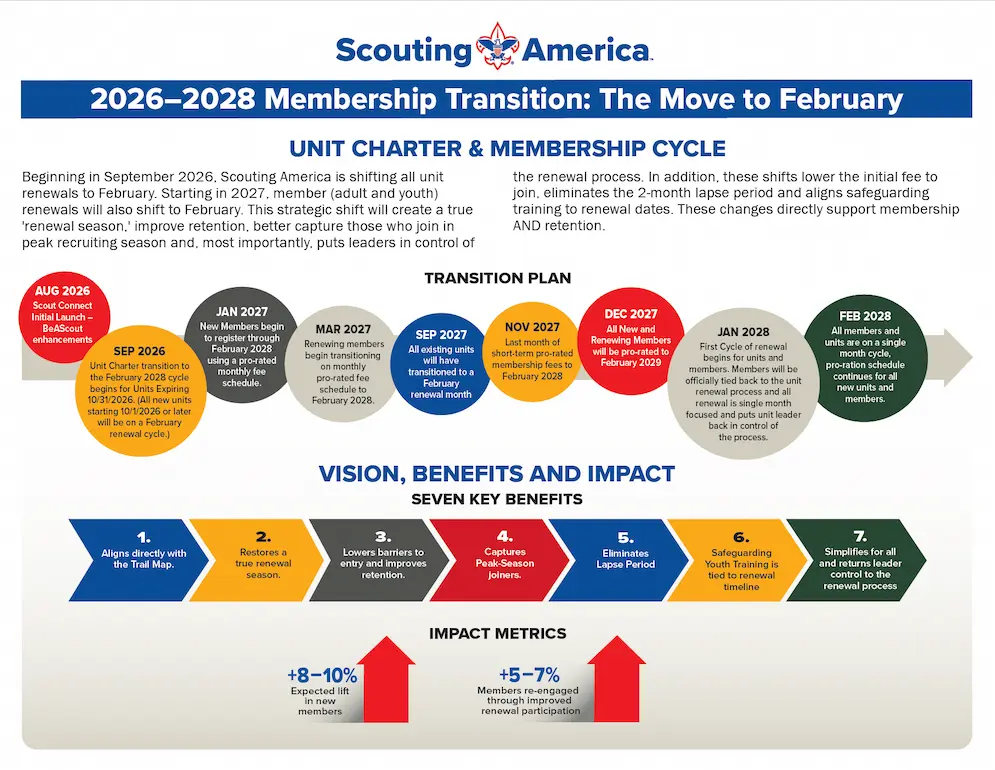
The infographic above summarizes the transition timeline. For most unit leaders, the biggest changes are straightforward:
- The membership lapse period will gradually disappear during the remainder of 2026.
- Unit charter renewals beginning this fall will transition toward a common February renewal month.
- By February 2028, every unit and every registered member will renew together during a single annual renewal season.
Yes, it means another change.
After several years of adjustments to membership registration, I know some of you are probably asking, “Now what?” Fortunately, this change simplifies the process rather than complicating it.
Why This Is Good News
From my perspective, this is less about paperwork and more about supporting our volunteers.
Our unit leaders volunteer because they want to plan campouts, lead hikes, mentor young people, and help Scouts grow. They don’t volunteer because they enjoy keeping spreadsheets of membership expiration dates.
Think about a typical pack with 40 Scouts. Under the current system, families may renew throughout the year, requiring leaders to check expiration dates regularly and send reminders month after month. Under the new process, everyone renews together during one renewal season. That’s simpler for families, easier for volunteers, and far less likely to result in someone unintentionally losing their membership.
Families should benefit as well. A simpler, more predictable renewal process—and prorated membership for new members during the transition—should make it easier to join Scouting and easier to remain active.
Returning to a common renewal cycle won’t eliminate every administrative task, but I believe it will make renewal far more predictable.
It should mean:
- One organized renewal season instead of managing renewals throughout the year.
- Less confusion for families.
- Fewer unintended lapses in membership.
- Simpler planning for unit leadership.
- More time focused on delivering great Scouting.
Perhaps just as important, unit leaders will once again play the central role in renewing their members. Instead of relying primarily on individual families to renew throughout the year, units will once again have the opportunity to work with families during one coordinated renewal process.
Based on the conversations I’ve had with many of our volunteers, I believe this is a change they’ll welcome.
What Should You Do?
For now, there’s nothing complicated you need to do.
As your unit approaches its charter renewal this fall, follow the guidance and timeline our council provides. We’ll continue sharing information, training opportunities, and reminders to help every unit navigate the transition successfully.
If your committee has become accustomed to managing renewals throughout the year, now would be a good time to begin discussing how you’ll transition back to a single annual renewal cycle.
Looking Ahead
The past few years have brought more changes to membership registration than any of us would have preferred. Change is rarely easy, especially when volunteers are already giving so much of their time.
The encouraging news is that this change is intended to simplify the process, not make it more complicated.
Every hour a volunteer spends chasing renewal dates is an hour they aren’t planning campouts, teaching outdoor skills, recruiting new families, or mentoring young people. Administrative processes should support Scouting — not get in the way of it.
If this new process gives our volunteers more time to do what they do best — changing young lives through Scouting — then it’s a change worth making.
Yours in Scouting,
Ron Gardner
Scout Executive & CEO
Originally published July 17, 2026
