Every fall, hundreds of families join Cub Scouting. They come looking for adventure, friendships, and opportunities that help their children grow into capable, confident young people.
Most begin with excitement and high expectations.
Yet every year, some quietly disappear.
It’s easy to assume that’s simply the nature of youth programs. Schedules change. Interests evolve. Life gets busy. While that’s certainly true for some, I’ve come to believe many departures have a different cause.
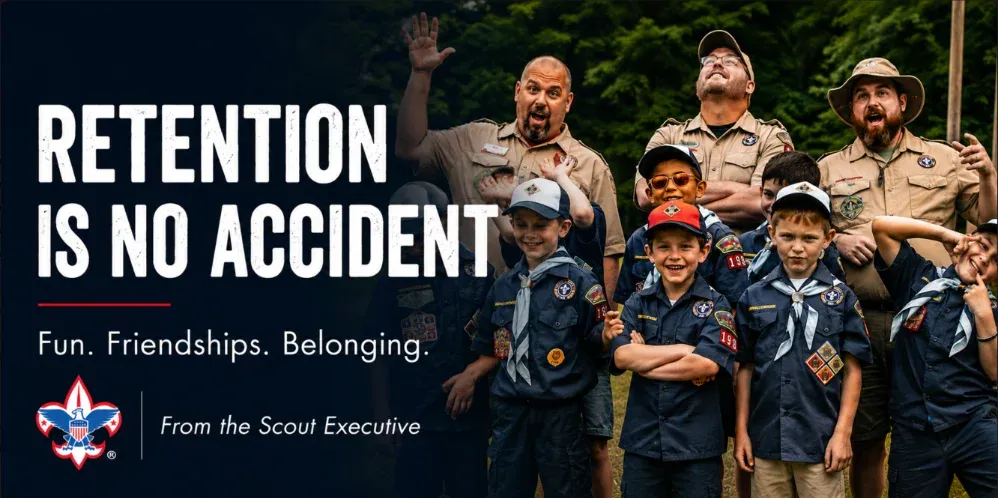
Retention isn’t accidental.
Neither is losing families.
The strongest packs don’t build lasting membership by chance. They intentionally create an experience that makes new families want to return. Other packs—often without realizing it—create obstacles that slowly push them away.
Recently, Scouting America gathered feedback from Cub Scout leaders and parents from councils across the country. The findings reinforced something many experienced leaders have observed for years: retention has less to do with recruiting the right families than with delivering the experience we promised.
That experience begins long before a Scout earns the first badge.
A new family can forgive an occasional mistake. They understand that every leader is a volunteer. What they have a harder time overlooking is uncertainty.
Meetings that feel disorganized. Activities that seem chaotic. Last-minute schedule changes. Emails or texts that never arrive. Parents who don’t know where to find the calendar or whom to contact with a question.
None of these issues seems significant on its own. Together, they create doubt. And doubt causes people to drift away.
The opposite is just as powerful.
A warm welcome. A leader who remembers a child’s name. Clear communication. A well-organized meeting. An invitation to the next activity before the family leaves the parking lot.
Those aren’t complicated ideas.
They’re intentional ones.
Children don’t join Cub Scouts because they’re looking for another classroom.
They join because they want adventure.
Over their first few months, they should experience well-planned, fun, purpose-driven den and pack meetings, along with hikes, campfires, outdoor games, service projects, and other adventures that bring the program to life. When learning is woven naturally into those experiences, advancement follows—and young people quickly discover what makes Scouting different.
Parents are every bit as important.
Most are willing to help. They simply need someone to show them where they fit. The healthiest packs don’t expect every parent to become a den leader. They invite each family to contribute in meaningful, manageable ways. One helps with a campfire. Another organizes a hike. Someone else coordinates refreshments or assists with a service project.
Small opportunities to help become ownership.
Ownership becomes commitment.
After reading the national recommendations, I kept coming back to one simple conclusion.
Retention isn’t accidental.
Successful packs intentionally create an experience that makes new families want to return.
When communication is clear, meetings are organized, leaders are prepared, and young people are having fun, families return. Friendships deepen. Parents become volunteers. Scouts grow in confidence. The pack becomes stronger.
If you’re looking for practical ideas, we’ve posted the full recommendations on our website. They’re worth reading and discussing with your pack leadership team.
Learn more: What Packs Can Do to Help Increase Retention
As another membership season begins, I hope every pack celebrates every new youth who joins. But once those applications are turned in, our most important work begins.
Every child who joins Cub Scouting deserves the chance to discover everything this program has to offer. Whether that happens depends less on the promise we make at recruitment and more on the experience we deliver after they arrive.
Successful packs understand that.
Retention is no accident.
Yours in Scouting,
Ron Gardner
Scout Executive & CEO
